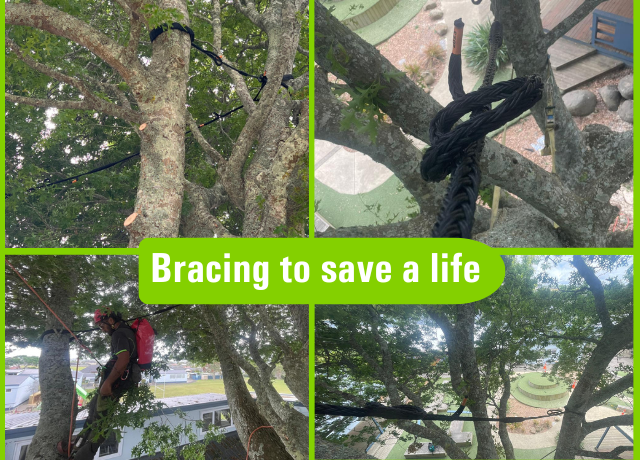
When to consider bracing your tree
Trees are a valuable long-term asset, but in New Zealand’s changeable climate, even healthy trees can be vulnerable to structural failure. Tree bracing or cabling is a specialised arboricultural technique designed to provide additional support while retaining the tree’s natural form and function.
Bracing or cabling is commonly recommended when a tree has weak branch unions, such as co-dominant stems where two large leaders grow closely together. These junctions are prone to splitting, especially during high winds, heavy rain, or storms—conditions many parts of New Zealand experience regularly. Cabling can also help support long, heavy limbs that may overextend due to age, species characteristics, or uneven growth.
Storm damage is another key reason to consider this option. Trees that have partially failed, cracked, or suffered limb loss may still be structurally viable. Rather than removing a mature tree, bracing or cabling can stabilise it, reduce risk, and extend its lifespan. This is particularly valuable for established trees that provide shade, shelter, or visual appeal.
Tree bracing is also useful for heritage or protected trees, where preservation is preferred over removal. Modern systems are flexible and non-invasive, allowing natural movement while reducing stress on vulnerable areas. When installed correctly, they adapt as the tree grows and help redistribute load during adverse weather.
It’s important to note that tree bracing or cabling is not a DIY solution. A qualified arborist will assess the tree’s structure, health, species, and location to determine whether this approach is appropriate. In some cases, pruning or removal may still be the safer option.
If you’re concerned about a tree on your property, professional advice can help you balance safety, longevity, and environmental value—keeping your trees standing strong for years to come.