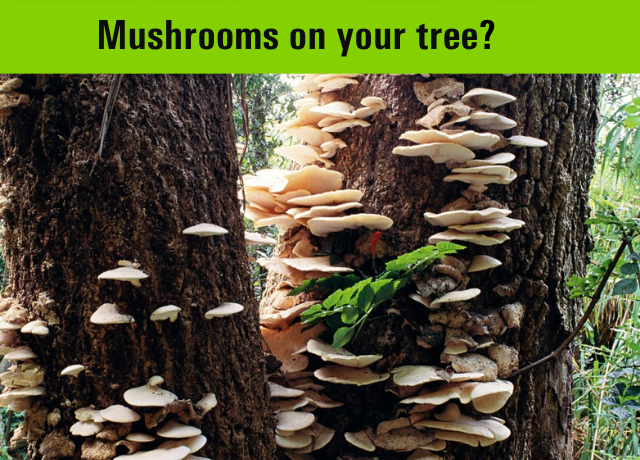
Should you be worried about mushrooms growing on your tree?
Finding mushrooms or large, shelf-like fungi growing on the trunk or around the base of a tree can be alarming. Many New Zealand homeowners immediately assume the tree is dying or needs to be removed. Fortunately, that isn’t always the case.
Not every tree with bracket fungi is dangerous, but every tree with bracket fungi deserves a closer look.
Fungal brackets, often called bracket fungi or conks, are the visible fruiting bodies of fungi living inside the wood. They are much like the mushroom of a much larger organism hidden within the tree. By the time these fruiting bodies appear, the fungus has often been present for several years, slowly breaking down wood beneath the bark.
The important question isn’t simply “Does my tree have fungus?” but rather “How is the fungus affecting the tree’s strength and stability?”
The fungal bracts indicate decay, however, the tricky part is identifying if the tree is safe. As arborists, we look at the whole tree and make an assessment on its safety based on other indicators of structural decline alongside the bracts.
These include:
The species of fungus present.
The location of the fungal brackets.
The size and age of the tree.
The amount of visible decay.
Root health and soil condition.
Crown vitality and leaf growth.
Structural defects such as cracks, cavities or included bark.
The likelihood of the tree causing damage if it were to fail.
Only by looking at the whole tree can we determine whether a tree remains safe or requires management.
Common problem fungi in Auckland trees include the Armillaria or honey fungus. It causes Armillaria root rot, and as there is no cure, a tree with this root rot would be recommended for removal.
Ganoderma bracts can look quite stunning on a tree trunk, but indicates heartwood decay where the inside of the tree becomes soft and spongy.
Does a tree with heartwood decay have to be removed?
Heartwood decay does not directly kill trees, but the decay in the heartwood does compromise the tree’s ability to support itself and stay stable in bad weather. From a distance, an infected tree may look vigorous, yet its ability to withstand strong winds or heavy limbs has been significantly reduced.
If decay is detected early, careful tree management can often reduce the risk, depending on the species, location, and condition of the tree.
There may be ways an arborist can help your tree cope with weakened structural integrity. Good tree care won’t eliminate existing decay, but it can reduce environmental stress and help the tree remain healthy for longer.
Don’t ignore the warning signs.
If you’ve noticed mushrooms or shelf-like fungi growing on or near one of your trees, don’t panic—but don’t ignore them either.
Early assessment is often the difference between retaining a valuable tree safely and facing an unexpected tree failure after a storm.
A qualified arborist can look at the type of fungus, assess the extent of any decay, and recommend the most appropriate course of action.