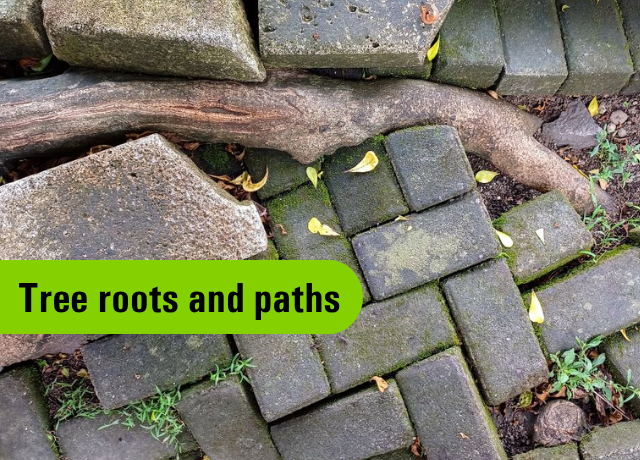
Tree roots and paths
Tree roots are often blamed when paths crack or sections of a house begin to shift, but the reality is a bit more nuanced. Roots don’t actively “seek out” concrete or foundations to cause damage—instead, they grow in search of water and stability. When that happens to be beneath a path, driveway, or near a structure, problems can develop over time.
Roots naturally expand in search of moisture and oxygen, typically within the top 600mm of soil. If there are small gaps, poorly compacted fill, or moisture variations under paving or foundations, roots will exploit these areas. As they thicken, they exert pressure, which can lift pavers, crack concrete, and in some cases contribute to minor structural movement in buildings—especially older homes with shallow foundations.
One of the most effective ways to mitigate root-related damage is early planning. Choosing the right tree species for the available space is key. Large, vigorous-rooting trees planted too close to paths or houses are far more likely to cause issues down the line.
Where trees are already established, physical root management can help. This is where trenching and root barriers come into play. Trenching involves digging a narrow trench 600mm to 1000mm deep between the tree and the structure you want to protect. During this process, encroaching roots are carefully cut back using clean, professional techniques to minimise stress to the tree.
Once the trench is prepared, a root barrier—often a heavy-duty plastic membrane—is installed vertically in the ground. This acts as a deflection barrier, guiding future root growth downward or away from the area to protect. In simple terms, it’s like putting up an underground fence that redirects roots rather than stopping them entirely.
It’s important this work is done correctly. Poor root cutting or incorrect barrier installation can destabilise a tree or make the problem worse. An arborist can assess root structure, tree species, tree health, and soil conditions before any work begins. Done properly, the tree roots will be redirected, preferably downwards, but sometimes sideways, so it’s important that the barrier is deep enough and long enough to adequately protect the structure.
Root barriers don’t stop roots from growing, they just guide them away from the structures you want to protect.